High-resolution audio: everything you lot need to know
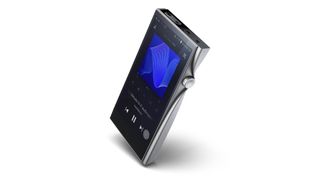
Later on years of niche positioning in the music world, "high-resolution audio" (or "how-do-you-do-res audio") finally striking the mainstream, cheers to a huge raft of support in streaming services (such every bit Tidal and Amazon Music Hd) and products (from smartphones to nearly digital hi-fi components).
Then why should yous care most hi-res audio? If you lot desire the best digital music experience possible or at least improve sound quality than you're currently used to (and why wouldn't you?), how-do-you-do-res audio is definitely worth investigating.
It tin can be a daunting prospect. After all, what exactly constitutes howdy-res audio, what do all the dissimilar file formats and numbers mean, where can you lot download or stream these loftier quality files, and what devices do you need to play information technology?
Indeed, where do you even begin?
That's where we come in. Our handy guide will take y'all through the ins and outs of hi-res sound. By the end, we hope you'll know everything you demand to know (and then some) and will be well on your way to enjoying your new and improved sonic lifestyle.
- 50 of the best hi-fi albums for audiophiles
What is high-resolution audio?
Unlike loftier-definition video, in that location'southward no unmarried universal standard for hi-res audio. In 2014, the Digital Entertainment Grouping, Consumer Electronics Association and The Recording Academy, together with record labels, formally defined high-resolution audio as "lossless audio that is capable of reproducing the full range of audio from recordings that accept been mastered from better than CD quality music sources".
In its simplest terms, hi-res sound tends to refer to music files that have a higher sampling frequency and/or bit depth than CD, which is specified at xvi-fleck/44.1kHz.
Sampling frequency (or sample rate) refers to the number of times samples of the signal are taken per 2nd during the analogue-to-digital conversion process. The more than bits there are, the more accurately the signal can be measured in the first example, so going 16bit to 24bit can deliver a noticeable leap in quality. Howdy-res audio files usually use a sampling frequency of 96kHz or 192kHz at 24bit. You can also take 88.2kHz and 176.4kHz files too.
Howdy-res sound does come with a downside though: file size. A hi-res file can typically be tens of megabytes in size, and a few tracks tin can rapidly eat up the storage on your device or be cumbersome to stream over your wi-fi or mobile network. Thankfully, storage is much cheaper than it used to exist, and so information technology'due south easier to get higher-chapters devices. And technologies such as MQA (see below) have arrived to help tackle that.
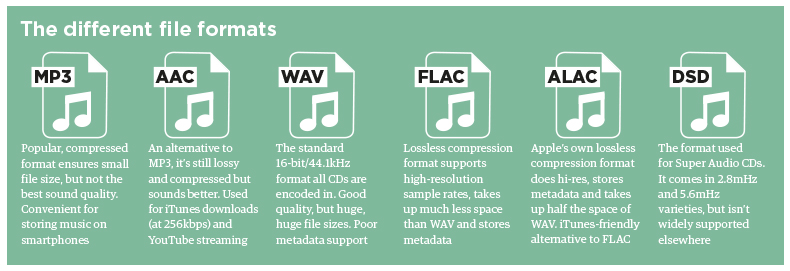
That'due south not all: in that location are as well several dissimilar how-do-you-do-res audio file formats to choose from, all of which have their own compatibility requirements.
They include the popular FLAC (Free Lossless Audio Codec) and ALAC (Apple Lossless Sound Codec) formats, both of which are compressed but in a way which means that, in theory, no information is lost. Other formats include the uncompressed WAV and AIFF formats, DSD (the format used for Super Sound CDs) and the more contempo MQA (Main Quality Authenticated).
The relative merits of each of the formats can exist argued, but the most crucial result will be the file'south compatibility with your called products and software.
Hither's a breakdown of all the chief file formats:
MP3 (non hi-res): Popular, lossy compressed format ensures small file size, just far from the best sound quality. User-friendly for storing music on smartphones and iPods, but doesn't support howdy-res.
AAC (non hi-res): An alternative to MP3s, it's lossy and compressed but sounds better. Used for iTunes downloads, Apple Music streaming (at 256kbps) and YouTube streaming.
WAV (hi-res): The standard format all CDs are encoded in. Neat audio quality but information technology's uncompressed, pregnant huge file sizes (specially for how-do-you-do-res files). Information technology has poor metadata back up (that is, album artwork, artist and song title information).
AIFF (hi-res): Apple'due south culling to WAV, with better metadata support. It is lossless and uncompressed (so big file sizes), merely not massively pop.
FLAC (hi-res): This lossless compression format supports hi-res sample rates, takes up near half the space of WAV, and stores metadata. Information technology'due south royalty-gratuitous and widely supported (though not by Apple tree) and is considered the preferred format for downloading and storing hullo-res albums.
ALAC (how-do-you-do-res): Apple's ain lossless compression format also does hello-res, stores metadata and takes upwardly half the space of WAV. An iTunes- and iOS-friendly culling to FLAC.
DSD (hi-res): The single-bit format used for Super Audio CDs. It comes in 2.8MHz, v.6mHz and 11.2mHz varieties, but isn't widely supported.
MQA (hello-res): A lossless compression format that efficiently packages hi-res files with more emphasis on the time domain. Used for Tidal Masters howdy-res streaming, and product support is picking up pace.
- MP3, AAC, WAV, FLAC: all the audio file formats explained
What'southward so good about howdy-res sound?
The main claimed do good of loftier-resolution audio files is superior sound quality over compressed audio formats such as MP3 and AAC.
Downloads from sites such as Amazon and iTunes, and streaming services such as Spotify, use compressed file formats with relatively low bitrates – such as 256kbps AAC files on Apple tree Music and 320kbps Ogg Vorbis streams on Spotify.
The employ of lossy compression ways data is lost in the encoding procedure, which in turn ways resolution is sacrificed for the sake of convenience and smaller file sizes. This has an effect upon the sound quality – those formats aren't telling the full story of our favourite songs.
This might be fine when y'all're listening to Spotify playlists on your smartphone on the passenger vehicle on the morning commute, but serious audiophiles and music fans should want better. This is where high-resolution audio comes in.
To illustrate why it should sound better than MP3, for example, let'due south compare the relative bitrates. The highest quality MP3 has a bitrate of 320kbps, whereas a 24-bit/192kHz file has a data rate of 9216kbps. Music CDs are 1411kbps.
The hi-res 24-flake/96kHz or 24-scrap/192kHz files should, therefore, more than closely replicate the sound quality the musicians and engineers were working with in the studio. And they could be that very same recorded file, also. These files are labelled as "Studio Masters" in some cases.
With more than information on the file to play with, hi-res audio tends to boast greater item and texture, bringing listeners closer to the original functioning – provided your system is transparent enough.
What do I demand to play hi-res audio?
There'due south a huge multifariousness of products that tin playback hello-res audio. It all depends on how big or small you want your organization to be, how much your budget is, and what method you'll mostly be using to listen to your tunes. But it's never been easier to get involved, now that plenty of the digital and streaming ecosystem supports hi-res, and particularly as popular streaming platforms such equally Google Chromecast (although not AirPlay 2) do.
These days, fifty-fifty, you don't take to completely abandon your vinyl collection to get hi-res, either; turntables such as the Sony PS-HX500 let yous digitise your vinyl drove by ripping your record tracks into howdy-res audio files.
Smartphones
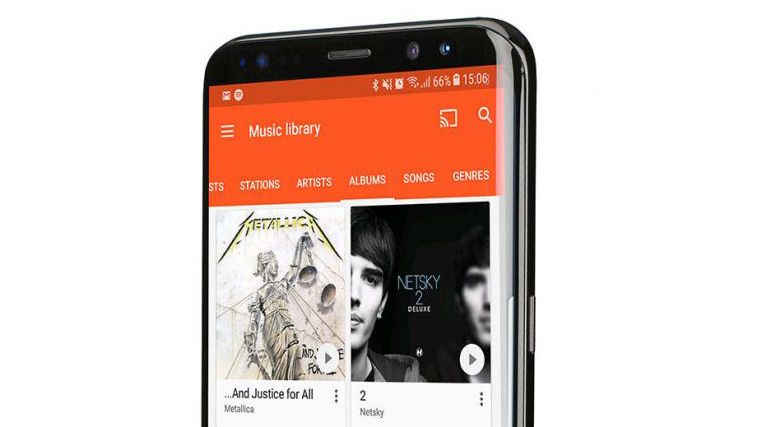
If you lot're going portable, smartphones are increasingly supporting how-do-you-do-res playback. This is restricted to college-end Android models, though – Apple tree iPhones then far don't back up hi-res audio out of the box (though there are ways around this by using the right app, and and then either plugging in a DAC or using Lightning headphones with the iPhones' Lightning connector).
Phones that have USB-C sockets instead of 3.5mm headphones jacks for music playback – as is becoming the norm – can boost their USB-C output with adapters such as Zorloo'south Ztella USB-C DAC.
Hi-res audio is increasingly piece of cake to stream wirelessly thanks to new advancements in Bluetooth. Phones with aptX Hard disk Bluetooth support (which many these days accept, although Apple's iPhones are an exception) can wirelessly transmit hi-res sound to aptX HD-supporting headphones (such equally the Sony WH-1000XM4 and WH-1000XM3 and Bowers & Wilkins PX7 dissonance-cancelling headphones).
- aptX Hd Bluetooth: What is information technology? How can you get information technology?
Portable music players
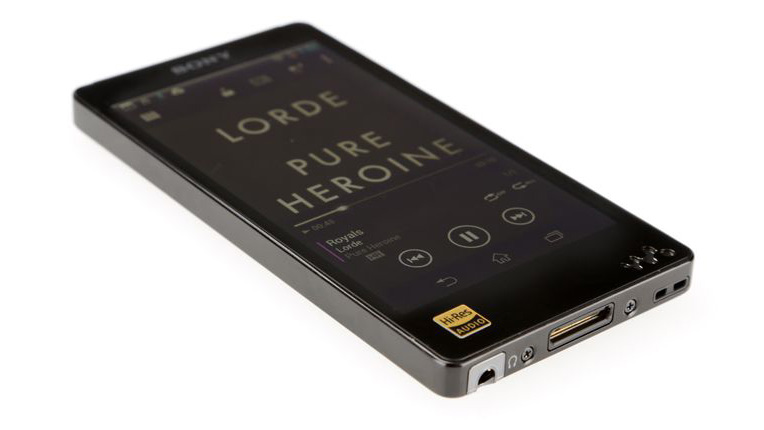
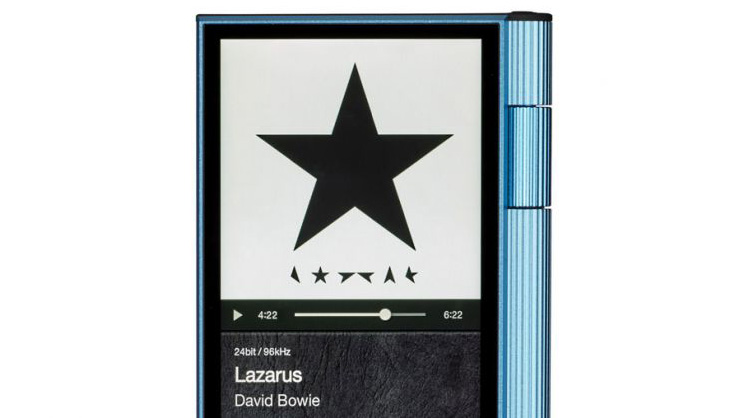
Alternatively, there are plenty of defended portable hi-res music players such as various Sony Walkmans and Honour-winning Astell & Kerns and Cowons that offer more than storage space and far better sound quality than a multi-tasking smartphone. More digital players than not support howdy-res audio, although again an Apple product is the exception, this fourth dimension the iPod Affect.
Desktop
For a desktop solution, your laptop (Windows, Mac, Linux) is a prime source for storing and playing hi-res music (later on all, this is where yous'll be downloading the tunes from hi-res download sites anyhow), but make certain the software you use to play music also supports hi-res playback. Apple iTunes, for example, doesn't back up it, even if your MacBook does, so you'll demand to purchase and download split music playing software. The likes of Channel D's Pure Music and Amarra are worth considering for a Mac. On a PC? Attempt JRiver Media Center.
DACs
Nosotros wouldn't only rely on your calculator or phone's internal DAC to do hi-res sound justice, either. A USB or desktop DAC (such as the Cyrus soundKey, Chord Mojo or Audiolab Grand-DAC nano) is a skilful way to get great sound quality out of hi-res files stored on your computer or smartphone (whose audio circuits don't tend to be optimised for sound quality). Simply plug a decent digital-to-analogue converter (DAC) in between your source and headphones for an instant sonic heave.
- All-time DACs: USB, portable and desktop DAC
Music streamers
If you're after a proper hi-fi gear up-upwards, you'll demand to await into music streamers that support how-do-you-do-res, and highly recommendable contenders include the Audiolab 6000N Play, Cambridge CXN V2 and NAD C 658. This is especially if you lot'll exist storing your growing hi-res library on a NAS (Network Attached Storage, substantially a difficult-drive with processing built in), which we would recommend.
Systems
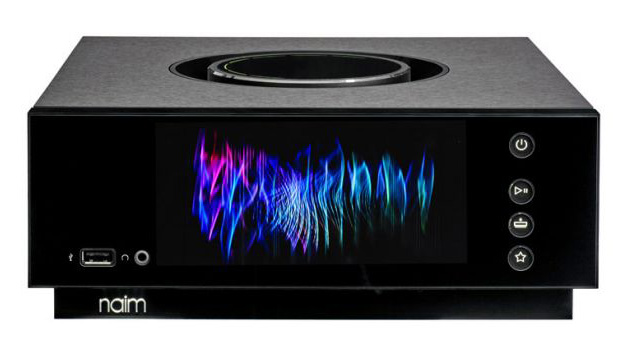
In that location are enough of other products that also support hi-res playback, including hybrid DAC-amp-streamer systems (Moon Neo Ace), speaker systems with everything built into them (KEF LS50 Wireless 2), just-add together-speaker systems (Marantz PM7000N) and electric current AV receivers (Sony STR-DN1080).
The ever-popular Sonos multi-room system nonetheless has no plans to support hello-res audio, and neither does Apple tree. Simply that has led rival companies such equally Bluesound to offering hi-res playback across their range of connected products (for a higher price, of course).
Wireless speakers
At the higher cease of the wireless speaker market place yous'll observe hullo-res support the norm. The likes of the Naim Mu-and so Qb 2nd Generation, Linn Series three and Bowers & Wilkins Formation Wedge are all able to handle hullo-res file playback over wi-fi.
- Best wireless speakers 2021
Where can I purchase and download hi-res music?
At present that you're armed with all this information on hi-res music, your next question should be: where can I get all these glorious hi-res music tracks?
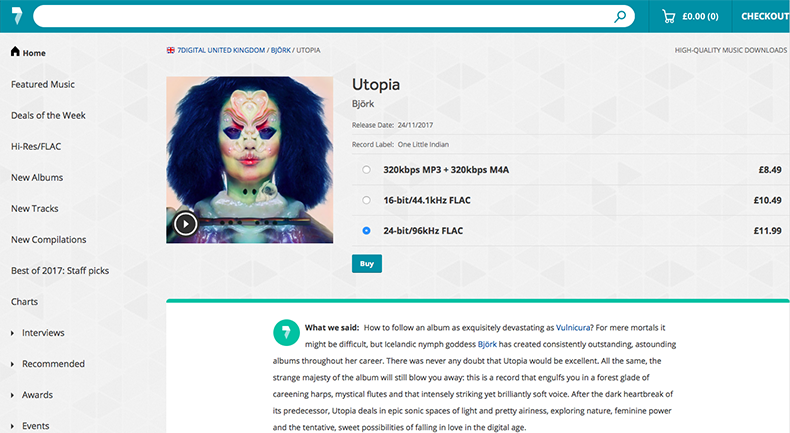
There are currently a handful of UK download sites that let you lot purchase and download single tracks and full albums in various hi-res formats. There are besides plenty of US and European sites, though not all of them allow you purchase from the United kingdom of great britain and northern ireland.
Major music labels such every bit Sony, Warner and Universal accept made their extensive music catalogues available to these howdy-res download services – which is a real shot in the arm for fans of high-resolution audio. With all sites, make sure it'southward clear what file format and bitrate you lot are buying. Ultimately, you lot may end upward with a favourite get-to site, but fifty-fifty then, it's worth checking across the unlike sites for the same album or track, as well, every bit some stores tin offering better prices than others.
Hither are the summit United kingdom of great britain and northern ireland hi-res download sites:
7Digital
With a strong catalogue offering hi-res music from all genres and a website that makes ownership music easy, 7digital is an excellent all-rounder. There'south an authentic search role and the website is simple to navigate. You lot can hands spot hi-res recordings thanks to a '24bit FLAC' badge on an album or song's thumbnail, and there's too a dedicated howdy-res section. The sole drawback is that information technology only offers downloads in the FLAC format. Prices are affordable, though, and you can purchase private tracks every bit well as full albums.
Qobuz Sublime
Music discovery and forepart-end intuitiveness get full marks on French download store Qobuz. Both the website and dedicated app are easy to navigate, and you tin search by genre or new releases, which can be sorted by sample rate. There is a strong Francophile focus, although the catalogue is growing more varied every day. Pricing is competitive, but if yous opt for the hybrid download-and-streaming Sublime+ service yous do go discounts when buying how-do-you-do-res albums.
HDtracks
HDtracks may be one of the most established hi-res download stores, but it's in need of a refresh in looks and catalogue. It can feel aimed at an older audience (there'southward stiff focus on jazz, classical and dad rock), which can exist off-putting for wider audiences, peculiarly fans of more electric current, pop music. On the other hand, whereas other download sites offer FLAC as default, HDtracks lets you cull between FLAC, ALAC, WAV and AIFF (and the sampling rate for each) before downloading. There'south a option of DSD tunes, too, which is peachy for audiophiles.
- How to build the perfect how-do-you-do-fi system
Where tin can I stream hi-res music?
Non ready to download hi-res files, or simply prefer streaming? Tidal and Qobuz streaming services take offered hi-res and CD-quality streams for years, putting them ahead of rivals Spotify and Apple Music. And now that Amazon has joined the political party with its HD service, hello-res streaming is now firmly in the mainstream domain.
Tidal Masters
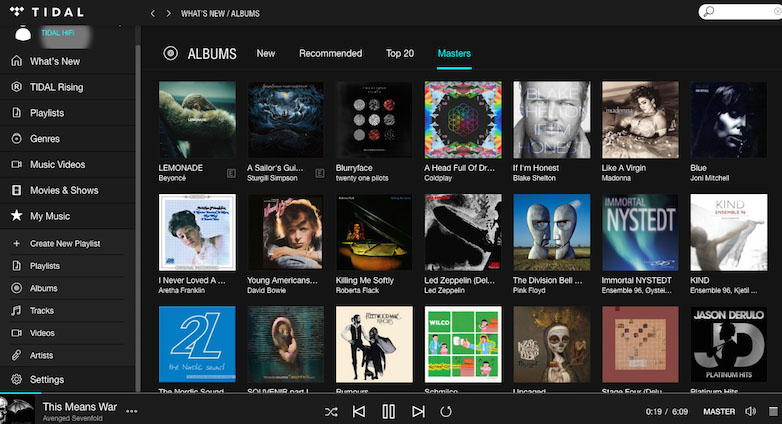
Tidal and MQA's partnership has brought united states i stride closer to mainstream hi-res music streaming. You'll need to subscribe to Tidal's HiFi tier (which offers CD quality streaming) to unlock the Masters section, and so you can stream hi-res MQA files through the desktop app and Android/iOS mobile apps.
Tidal'due south catalogue of MQA files is now well into the millions, with a resolution of upwards to 24-bit/96kHz (whatever 192kHz files will exist unpackaged to 96kHz past MQA'southward cadre decoding). With the right kit, the streamed tunes sound keen, too. It's a solid foundation from which the hello-res streaming experience tin only evolve.
Qobuz Sublime+
Qobuz strikes again here and says its hybrid download-and-streaming tier is '"the best music subscription in the world." This top-tier package offers howdy-res streaming upwards to 24bit/192kHz files (also as CD quality tracks) on its desktop and mobile apps, with its 50-million-track catalogue including more than than 240,000 hullo-res albums.
The big downside is the price - yous take to pay an upfront £250 annual fee to use Sublime+ and all its perks (which does include good discounts when buying hi-res albums). And in comparison, we found Tidal offers more drive and dynamism when information technology comes to audio quality. Qobuz's hullo-res streaming tier is a great venture, but only if you lot're fully committed to hi-res streaming.
Amazon Music Hard disk
The about recent entrant into the hi-res streaming service earth is Amazon – and its arrival at the end of 2019 largely marked hi-res streaming going mainstream. The cheapest hi-res service of the three, the value-packed streaming service is up at that place with the best cheers to its Intuitive desktop and mobile apps, expert CD-quality and hi-res library and excellent value.
What's next for hi-res audio?
With more than support than ever before, hi-res sound is a viable choice for anyone interested in audio quality, whether part of your home sound organization or when on the move.
Whether the biggest players – Apple, Sonos and Spotify – volition e'er natively support hi-res remains to be seen, but there are enough of other, increasingly affordable means that you can commencement delving into the hullo-res audio world. (Interestingly, 360-degree or environment audio formats such as Sony 360 Reality Audio and Dolby Atmos Music respectively are also making headway in offering higher quality, if not necessarily 'hi-res', music experiences, so they're other options for melomaniacs to explore.)
With this wider availability, more people are able to acquire and understand exactly what high-resolution audio is, and the benefits it can bring to music. In that location's enough of content out in that location, and at that place's plenty of hardware to go with it.
So if yous want the ultimate sonic solution, you lot know what to practise.
MORE:
Where is Spotify Hi-Fi? And do nosotros still want a lossless Spotify tier?
iii of the best high-res sound systems
Here'south a superb-sounding hi-fi system with streaming skills
All-time hi-fi systems 2021
DOWNLOAD HERE
Posted by: hopperounpat.blogspot.com